
Valencia Marathon Weather History: 16 Years of Race Data
No rain in 16 years of race-hours data, a 13°C (55°F) average and a 21°C (69°F) high in 2025, the warmest yet: what Valencia Marathon weather looks like.
Valencia is a flat, sea-level course in early December, and the weather history says the date is a good one. Across the 16 years in our race-day history, the average temperature during race hours is 13°C (55°F), with a typical low of 9°C (49°F) and a typical high of 16°C (61°F). Not one of those 16 race days logged rain during race hours.
The part worth planning for is the warm end. Seven of the 16 years reached a high of 18°C (64°F) or more, and the most recent edition, 2025, was the warmest in that history at 21°C (69°F). Valencia's weather is calm and dry, but "cool" is not guaranteed, and the later start waves run into the warmest part of the day.
Valencia Marathon Weather, Year by Year
This is the same race-hours history shown on the Valencia Marathon race page: nearby station readings for the hours the race is on the course, 16 years in all. The low and high cover race hours, so the high usually arrives well after the first wave starts at 8:15 AM. Dew point is the average for race hours. RunScore runs from 0 to 10, with 10 the best conditions.
| Year | Low / High | Conditions | Rain | Dew Point | RunScore |
|---|---|---|---|---|---|
| 2025 | 11°C / 21°C (51°F / 69°F) | Clear | None | 9°C (49°F) | 7 |
| 2024 | 9°C / 17°C (48°F / 62°F) | Partly cloudy | None | 11°C (52°F) | 8 |
| 2023 | 4°C / 14°C (40°F / 58°F) | Partly cloudy | None | 1°C (33°F) | 10 |
| 2022 | 9°C / 14°C (48°F / 58°F) | Partly cloudy | None | 7°C (45°F) | 9 |
| 2021 | 11°C / 16°C (52°F / 61°F) | Clear | None | 1°C (33°F) | 9 |
| 2020 | 7°C / 13°C (45°F / 56°F) | Clear | None | -1°C (31°F) | 10 |
| 2019 | 13°C / 18°C (56°F / 65°F) | Clearing in the afternoon | None | 7°C (45°F) | 7 |
| 2018 | 9°C / 18°C (48°F / 65°F) | Partly cloudy | None | 5°C (41°F) | 8 |
| 2017 | 8°C / 18°C (46°F / 64°F) | Partly cloudy | None | 4°C (39°F) | 9 |
| 2016 | 13°C / 16°C (55°F / 61°F) | Partly cloudy | None | 6°C (42°F) | 8 |
| 2015 | 8°C / 19°C (46°F / 66°F) | Partly cloudy | None | 9°C (49°F) | 8 |
| 2014 | 12°C / 18°C (54°F / 64°F) | Partly cloudy | None | 5°C (41°F) | 8 |
| 2013 | 9°C / 15°C (48°F / 59°F) | Clearing in the afternoon | None | 4°C (39°F) | 10 |
| 2012 | 13°C / 18°C (55°F / 65°F) | Partly cloudy, rain noted in the day summary | None in race hours | 12°C (54°F) | 7 |
| 2011 | 8°C / 17°C (47°F / 63°F) | Partly cloudy | None | 6°C (43°F) | 9 |
| 2010 | 4°C / 8°C (40°F / 47°F) | Partly cloudy, late afternoon rain noted in the day summary | None in race hours | 2°C (36°F) | 10 |
Source: racecast.io race-day weather history, 16 years of race-day history.
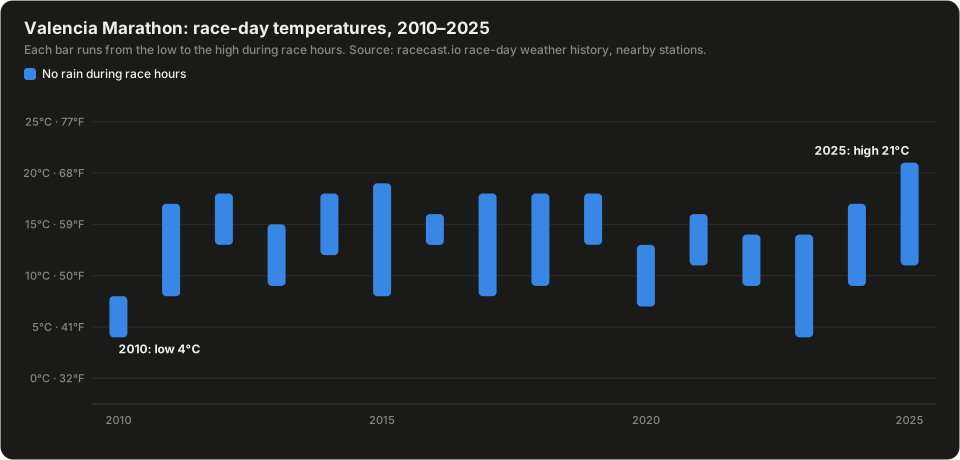
Each bar is one race morning, from the low to the high during race hours. Same data as the table above.
Valencia's range is narrow. Fifteen of 16 years had a race-hours high between 13°C and 21°C (56°F and 69°F), and the lows sat between 4°C and 13°C (40°F and 56°F). Only 2010, at an 8°C (47°F) high, fell outside that.
Why December Works in Valencia
Valencia sits on Spain's Mediterranean coast, and the course is flat at sea level, so there is no altitude or hill-driven temperature change to plan around. The race is in early December: recent editions ran on December 1 (2024), December 3 (2023) and December 7 (2025). By then the summer heat is long gone, which is the main reason the history is so stable.
The dry air matters too. The average dew point during race hours is 6°C (42°F), and even the muggiest year, 2012, only reached 12°C (54°F). That is far from the sticky range where sweat stops cooling you. Dew point is a separate issue from air temperature, and at Valencia it almost never makes the day feel harder than the thermometer says.
Wind is light as well. The race-hours average is 10 km/h (6 mph). We don't have a verified read on which stretches of the course catch a breeze, so we won't guess at one. Check the hourly wind in the forecast the week of the race.
The first wave starts at 8:15 AM and the ninth at 9:35 AM. The race-hours high comes later in the day, so the faster you run, the more of your race happens in the cooler part of the range. A runner in the last wave who finishes in 4:30 is on the course through the warmest hours.
The Warmest Years
2025: 21°C (69°F) and clear
The most recent edition is the warmest in our history, with race-hours temperatures from 11°C to 21°C (51°F to 69°F), clear skies and a dew point of 9°C (49°F). It scored a 7, tied for the lowest RunScore in the 16 years. The fast end of the field still ran very fast: John Korir won in about 2:02 and Joyciline Jepkosgei set a women's course record of 2:14:00. The slower end of a 30,777-finisher race had the warm hours to deal with.
2019, 2018, 2017, 2015, 2014 and 2012: highs of 18°C to 19°C (64°F to 66°F)
Six other years reached 18°C (64°F) or more. 2019 had the warmest start, 13°C (56°F), just above 2016 and 2012, then cleared in the afternoon. 2015 had the widest swing, from 8°C (46°F) to 19°C (66°F). 2012 had the highest dew point, 12°C (54°F), and a day summary that mentions rain, though none was recorded during race hours.
The Coolest Years
2010: 4°C to 8°C (40°F to 47°F)
The coldest edition by far, and the only year where the high stayed below 13°C (56°F). The day summary mentions late-afternoon rain, but nothing was recorded during race hours. If you run a cold, dry race you want a start layer and gloves, not a rain jacket.
2023 and 2020: scores of 10
In 2023 the range was 4°C to 14°C (40°F to 58°F) with a very dry 1°C (33°F) dew point. That was the year Sisay Lemma set the men's course record of 2:01:48. In 2020 it was 7°C to 13°C (45°F to 56°F) with the driest air in our history, a -1°C (31°F) dew point. Both scored a 10, the best RunScore.
How to Prepare for Valencia Weather
Dress for the start, not the average. Lows over the 16 years ran from 4°C to 13°C (40°F to 56°F). With the first wave at 8:15 AM and the last at 9:35 AM, you can stand around in the start area for a while before your wave goes. Wear an old top or a trash bag over your race kit and drop it in the start box.
Don't count on a bag drop. It is a paid, reserved-in-advance service, and the 2026 spaces showed as full on the organizer's page. If you didn't reserve a space, plan to bring only what you are willing to leave behind.
Plan for a warm back half. Seven of 16 years reached 18°C (64°F) or more, and the highs come later in the day. If you are in a later wave, expect your second half to be warmer than your start. Singlet and shorts, with the throwaway layer ready to shed in the first few kilometers, covers most scenarios.
Use sun protection. Skies were clear or clearing in five of 16 years, and the rest were partly cloudy. A cap and sunscreen are cheap insurance even in December.
Drink early and steadily. Dry air at a 6°C (42°F) average dew point means sweat evaporates quickly, so you may not feel how much you are losing. Aid stations run every 4 to 5.5 km (2.5 to 3.5 miles), starting near km 5.5 (mile 3.4), according to the 2026 course map.
Keep the pace plan loose. In a typical year the weather is not the story. In a warm year like 2025, the heat builds through the race, so a slightly conservative first half leaves you something for the warm hours.
More Weather and Gear Guides
- Valencia Marathon forecast: see the race-day forecast and pace calculator on racecast.io.
- What to Wear by Temperature: a clothing guide for any race morning.
- Running a Hot Marathon: how to adjust when the day runs warm, as 2025 did.
- Running a Cold Marathon: for a 2010-style start.
- How Wind Affects Your Marathon: what a headwind costs and how to run around it.