
Athens Marathon Weather History: 22 Years of Race-Day Data
Athens Marathon weather in 22 years of data: a 13°C (56°F) average start, rain in only 2 years, and the warm-start years that scored 4.
The Athens Marathon is run in November, and most years the weather behaves like it. Across the 22 years racecast.io has race-day data for, the average start is 13°C (56°F) and a typical finish hour reaches 19°C (66°F). Rain fell during race hours in only 2 of those years, both times lightly. On paper it is a gentle, stable race.
The catch is the route. Athens is a point-to-point course from Marathon to the Panathenaic Stadium, and the organizers describe the climbing as running on and off from about km 11 to km 31 (miles 7 to 19). That is exactly the part of the morning when the day warms up. In 8 of the 22 years the high reached 20°C (68°F) or more, and the four worst-scoring years all came with a warm start and a dew point above 55°F (13°C).
Athens Marathon Weather, Year by Year
This is the same race-day history shown on the Athens Marathon race page: 22 years of race-day history, from 2002 to 2025, using race-hours weather from nearby stations. "Start" is the low during race hours and "High" is the warmest hour. The history has no row for 2006 or 2020. RunScore is out of 10, and higher is better.
| Year | Start | High | Rain | Dew point | RunScore |
|---|---|---|---|---|---|
| 2025 | 18°C / 64°F | 22°C / 72°F | None | 16°C / 61°F | 4 |
| 2024 | 12°C / 54°F | 16°C / 61°F | None | 6°C / 42°F | 9 |
| 2023 | 14°C / 58°F | 22°C / 72°F | None | 11°C / 51°F | 6 |
| 2022 | 11°C / 51°F | 18°C / 65°F | None | 10°C / 50°F | 7 |
| 2021 | 13°C / 56°F | 16°C / 61°F | None | 11°C / 51°F | 7 |
| 2019 | 18°C / 64°F | 21°C / 69°F | None logged | 14°C / 58°F | 5 |
| 2018 | 10°C / 50°F | 18°C / 65°F | None | 9°C / 49°F | 7 |
| 2017 | 16°C / 60°F | 20°C / 68°F | None | 13°C / 56°F | 5 |
| 2016 | 15°C / 59°F | 20°C / 68°F | None | 4°C / 39°F | 7 |
| 2015 | 13°C / 56°F | 19°C / 66°F | None | 8°C / 46°F | 7 |
| 2014 | 12°C / 54°F | 19°C / 67°F | Light | 13°C / 55°F | 7 |
| 2013 | 11°C / 52°F | 21°C / 70°F | None | 12°C / 54°F | 7 |
| 2012 | 13°C / 56°F | 17°C / 63°F | None | 8°C / 46°F | 8 |
| 2011 | 9°C / 48°F | 9°C / 49°F | None | 2°C / 36°F | 10 |
| 2010 | 8°C / 47°F | 17°C / 62°F | None | 6°C / 43°F | 9 |
| 2009 | 16°C / 60°F | 17°C / 63°F | Light | 14°C / 58°F | 6 |
| 2008 | 15°C / 59°F | 18°C / 65°F | None | 7°C / 45°F | 8 |
| 2007 | 14°C / 57°F | 18°C / 64°F | None logged | 12°C / 53°F | 7 |
| 2005 | 11°C / 52°F | 17°C / 63°F | None | 7°C / 44°F | 9 |
| 2004 | 12°C / 53°F | 19°C / 67°F | None | 10°C / 50°F | 8 |
| 2003 | 18°C / 65°F | 24°C / 75°F | None | 17°C / 63°F | 4 |
| 2002 | 12°C / 54°F | 23°C / 74°F | None | 13°C / 55°F | 6 |
"None logged" means the day's summary mentions rain (afternoon in 2019, late afternoon in 2007) but none was recorded during race hours.
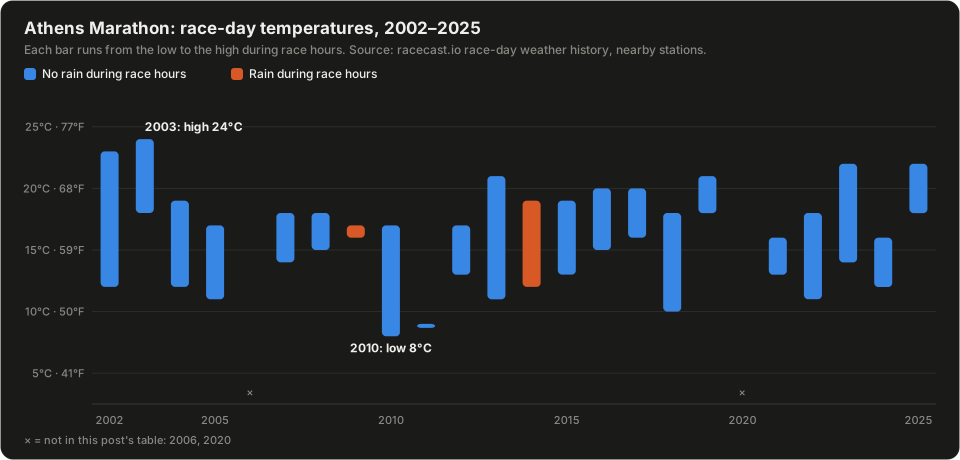
Each bar is one race morning, from the low to the high during race hours. Same data as the table above.
The race's 22-year average RunScore is 7, but the spread is wide: 4 in 2003 and 2025, 10 in 2011. The lowest scores did not come from rain or wind. They came from a start at 16°C (60°F) or warmer with a dew point of 13°C (55°F) or more.
Why the Weather Looks Like This
Two things shape what you will run in. The first is the date. A November race is mild on average, so the typical range is small: the average start is 13°C (56°F) and the average high is 19°C (66°F), a rise of about 6°C (10°F) over race hours. Most years sit close to that. Six of the 22 starts were 11°C (52°F) or cooler, and five were 16°C (60°F) or warmer.
The second is how long you are out there. The marathon gun goes at 8:30 AM, but the starting blocks run until about 10:15 (Block 15 is listed at 10:09). The first finishers arrive between about 10:40 and 11:15 AM, and slower runners are finishing into the afternoon, when the day is warmest. The table's "High" is the warmest hour, and your race will not necessarily hit it, but a runner on a four-hour pace spends the whole late morning on the course.
On an even-pace estimate that ignores the hills, a four-hour runner from Block 1 reaches km 11 at about 9:30 and the top of the Stavros climb near km 31 at about 11:30. That puts the hardest climbing in the warmer hours, and the downhill and flat run-in to the stadium comes after it. Wind is a smaller factor: it averages 11 km/h (7 mph) over race hours, so it matters less here than temperature does.
Check the start temperature and the dew point together. In the seven years with a dew point of 13°C (55°F) or higher, the scores were 4, 4, 5, 5, 6, 6 and 7. Dry-air years were far kinder: in 2016 the high reached 20°C (68°F) but the dew point was only 4°C (39°F), and the score was 7.
The Worst Weather Years
2003 and 2025: Warm Starts
2003 is the warmest year in this history: a 24°C (75°F) high, an 18°C (65°F) start and a 17°C (63°F) dew point, for a RunScore of 4. 2025 matched that score with a 22°C (72°F) high and an 18°C (64°F) start. Neither is a hot day by summer standards, but for a marathon that climbs for 20 km, a start in the high teens Celsius with humid air costs real time.
2019 and 2017: Mild but Humid
Both years scored 5. The start was 18°C (64°F) in 2019 and 16°C (60°F) in 2017, with dew points of 14°C (58°F) and 13°C (56°F). The 2019 daily summary mentions afternoon rain, but none was recorded during race hours.
2002: The Biggest Swing
2002 started at 12°C (54°F) and reached 23°C (74°F), a 20°F rise, the largest swing in the history. 2013 was next, starting at 11°C (52°F) and reaching 21°C (70°F). In those years the right kit at 8:30 AM was the wrong kit by 11.
The Best Weather Years
2011: The Windy, Cold Outlier
2011 had the best RunScore in the history, a 10. The temperature barely moved across race hours (9°C, or 48°F to 49°F), and the dew point was just 2°C (36°F). It was also the windiest year at 27 km/h (17 mph) on average, so it is the one case where the wind is the story.
2024, 2010 and 2005: Cool and Dry
All three scored 9. 2024 ran 12°C to 16°C (54°F to 61°F) with a dew point of 6°C (42°F). 2010 had the coldest start in this history, 8°C (47°F), warming to 17°C (62°F). 2005 ran 11°C to 17°C (52°F to 63°F).
The 2023 course record, Edwin Kiptoo's 2:10:34, was run at 14°C to 22°C (58°F to 72°F), a RunScore 6 day. The record does not need a perfect morning, but it does show the course is fast for a runner who handles the climb.
How to Prepare for Athens Race Morning
Dress for the climb, not the bus. The organizer gives every marathoner a thermal poncho, and there is no bag drop at the start, so whatever you wear to Marathon Town is what you carry or discard. On a typical 13°C (56°F) start, a singlet and shorts plus the poncho is enough. Our race day clothing by temperature guide covers the in-between mornings.
Plan for a warmer second half than the first. The average high is about 6°C (10°F) above the average start, and in 2002 and 2013 the gap was 10°C or more (18°F to 20°F). If your start is 8°C to 12°C (47°F to 54°F), expect to be hot by the middle climbs.
Watch the dew point as well as the temperature. If the forecast start is 16°C (60°F) or higher and the dew point is 13°C (55°F) or higher, treat it as one of the four hard years: slow your first climb by effort and hydrate earlier. Our dew point and marathon pace guide explains the numbers.
Use the course's sponges and water. Water is at every station every 2.5 km. Sponges sit between the isotonic stations at 7.5, 12.5, 17.5, 22.5, 27.5, 32.5 and 37.5 km. On a warm day, use them through the climbs from km 11 to km 31.
Carry gels for the second half. The course has gels at only two stations, at 10 km and 20 km. Take your own for the climbs after that.
Run the middle by effort. The road climbs on and off from about km 11 to km 31, and the Stavros junction near km 30 to 31 is the last and hardest section. Wind seldom matters here, but see our guide to wind and the marathon if the forecast shows a strong breeze. If it is warm, our hot marathon guide covers pacing and fluids.
If you start in a late block, check the forecast for later. Blocks run until about 10:15, so a late block starts well after the cool early hours.
More Athens Marathon Resources
- Athens Marathon Weather Forecast: See the race-day forecast and pace calculator on racecast.io.
- What to Wear by Temperature: A race-day clothing chart for every start temperature.
- Dew Point and Marathon Pace: Why humidity matters more than the air temperature.
- Running a Hot Marathon: Pacing and fluids for a warm race day.