
Philadelphia Marathon Weather History: 24 Years of Race Days
The Philadelphia Marathon averages 40°F (4°C) at the start. Rain fell in 2 of 24 years. See every race day since 2000, plus what to wear.
The Philadelphia Marathon is run the Sunday before Thanksgiving, and the weather record says what that means: cold, dry and rarely dramatic. Across 24 years of race-day data, the typical runner starts at 40°F (4°C) and finishes in about 49°F (9°C). Rain fell during race hours in only 2 of those years.
The surprise is how little the weather has varied. 17 of the 24 years earned a RunScore of 10, and none scored below 8. The real threat is the cold end of the range: starts in the low 30s, and in 2022 a wind that averaged 19 mph (31 km/h) on a morning that never got past 35°F (2°C). Here is what the full history looks like, and how to dress for it.
The Numbers: 24 Years of Philadelphia Marathon Weather
This is the same race-hours history shown on the Philadelphia Marathon race page, built from nearby weather stations. Low and high are the range during race hours, not the full day. The Rain column covers race hours only, so afternoon showers after the finish do not count. 2020 was cancelled, and 2005 has no row in the history.
| Year | Low / High (°F) | Low / High (°C) | Rain | Dew Point | RunScore |
|---|---|---|---|---|---|
| 2025 | 35 / 48 | 2 / 9 | None | 31°F (-1°C) | 10 |
| 2024 | 48 / 53 | 9 / 12 | None | 36°F (2°C) | 9 |
| 2023 | 39 / 52 | 4 / 11 | None | 29°F (-2°C) | 10 |
| 2022 | 33 / 35 | 1 / 2 | None | 9°F (-13°C) | 8 |
| 2021 | 33 / 45 | 1 / 7 | None | 27°F (-3°C) | 10 |
| 2019 | 41 / 43 | 5 / 6 | Light | 37°F (3°C) | 9 |
| 2018 | 33 / 44 | 1 / 7 | None | 31°F (-1°C) | 10 |
| 2017 | 35 / 51 | 2 / 11 | None | 34°F (1°C) | 10 |
| 2016 | 43 / 64 | 6 / 18 | None | 44°F (7°C) | 9 |
| 2015 | 40 / 50 | 4 / 10 | None | 26°F (-3°C) | 10 |
| 2014 | 41 / 51 | 5 / 11 | None | 24°F (-4°C) | 10 |
| 2013 | 52 / 62 | 11 / 17 | None | 50°F (10°C) | 8 |
| 2012 | 37 / 48 | 3 / 9 | None | 33°F (1°C) | 10 |
| 2011 | 51 / 60 | 11 / 16 | None | 45°F (7°C) | 8 |
| 2010 | 39 / 48 | 4 / 9 | None | 28°F (-2°C) | 10 |
| 2009 | 39 / 53 | 4 / 12 | None | 39°F (4°C) | 10 |
| 2008 | 25 / 35 | -4 / 2 | None | 17°F (-8°C) | 10 |
| 2007 | 41 / 42 | 5 / 6 | Light | 34°F (1°C) | 10 |
| 2006 | 40 / 48 | 4 / 9 | None | 33°F (1°C) | 10 |
| 2004 | 48 / 51 | 9 / 11 | None | 47°F (8°C) | 10 |
| 2003 | 45 / 56 | 7 / 13 | None | 47°F (8°C) | 9 |
| 2002 | 36 / 49 | 2 / 9 | None | 30°F (-1°C) | 10 |
| 2001 | 39 / 51 | 4 / 11 | None | 39°F (4°C) | 10 |
| 2000 | 34 / 39 | 1 / 4 | None | 24°F (-4°C) | 10 |
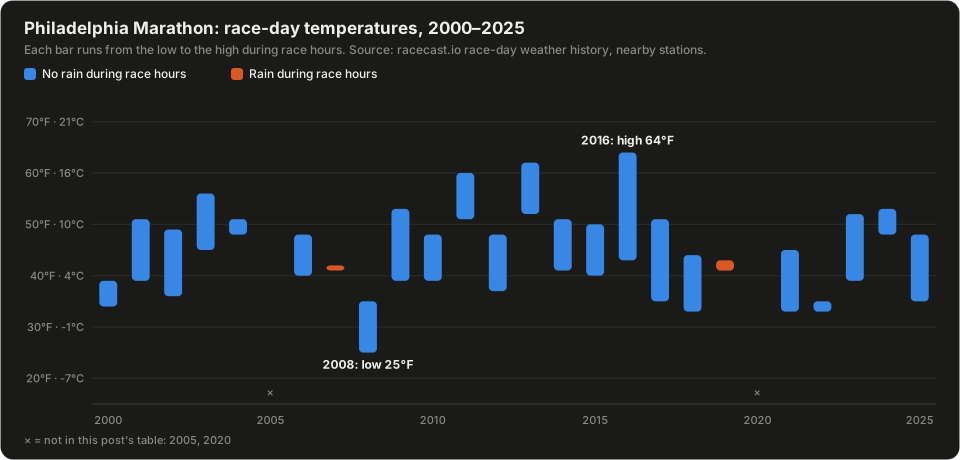
Each bar is one race morning, from the low to the high during race hours. Same data as the table above.
Only 3 of 24 years reached 60°F (16°C) during race hours (2011, 2013 and 2016), while 7 of 24 started at 35°F (2°C) or colder. If you pack for one extreme, pack for the cold one.
Why Late November Is So Steady Here
By the Sunday before Thanksgiving, Philadelphia has settled into late-fall weather. The summer heat is long gone and deep winter has not arrived, so the numbers cluster in a narrow band. In 14 of the 24 years, the race-hours high landed between 48°F (9°C) and 56°F (13°C). That is a comfortable range for running a marathon.
The 7:00 AM start keeps you in the cooler part of the day. The typical climb from start to finish is about 9 degrees (5°C), a gentle rise.
Moisture is the other stabilizer. The average dew point is 33°F (1°C), so the air is dry and sweat evaporates easily. Even the two muggiest years, 2013 and 2011, only reached dew points of 50°F (10°C) and 45°F (7°C). Along with 2022, they are the only years that scored an 8.
2022 is the outlier worth knowing. The race-hours range was just 33°F to 35°F (1°C to 2°C), the wind averaged 19 mph (31 km/h), and the dew point was 9°F (-13°C), the driest morning in this history. It was cold and windy rather than wet, and it scored an 8, tied with 2013 and 2011 for the lowest RunScore in it.
The Worst Weather Years
2022: The Windiest Morning
The temperature barely moved, from 33°F to 35°F (1°C to 2°C), so there was no warm-up to wait for. Wind averaging 19 mph (31 km/h) during race hours is the highest in the 24 years we have and more than double the usual 8 mph (13 km/h). At 34°F (1°C) with a 19 mph wind, the wind chill sits in the low 20s°F (around -5°C), which is why a wind-resistant layer matters more than an extra shirt on a morning like that.
2008: The Coldest Start
The 2008 race began at 25°F (-4°C) and reached only 35°F (2°C). That is the coldest start in the 24 years we have, 8 degrees colder than the next-coldest start (33°F, in 2022, 2021 and 2018). The air was dry, with a 17°F (-8°C) dew point, and no rain fell during race hours.
2013 and 2011: The Mild Extreme
The warm years are the other half of the risk. In 2013 the race ran from 52°F to 62°F (11°C to 17°C) with a 50°F (10°C) dew point. In 2011 it ran from 51°F to 60°F (11°C to 16°C). Neither is hot in an absolute sense, but for late November they were the warm end of the range. The single warmest day was 2016, which started at 43°F (6°C) and climbed to 64°F (18°C), a 21-degree rise within race hours.
2007 and 2019: The Only Rain
Rain fell during race hours in only these two years, and both times it was light. Temperatures stayed in a narrow, cool band, 41°F to 42°F (5°C to 6°C) in 2007 and 41°F to 43°F (5°C to 6°C) in 2019. Cold and damp calls for a rain layer you can shed. The Philadelphia Marathon runs rain or shine.
The Best Weather Years
Seventeen of the 24 years earned a perfect RunScore of 10, so there is no shortage of good days. A few stand out for how closely they match the ideal marathon range of roughly 40°F to 50°F (4°C to 10°C).
2023 ran from 39°F to 52°F (4°C to 11°C) with no rain and a dew point of 29°F (-2°C). 2025, the most recent race, ran from 35°F to 48°F (2°C to 9°C) with a 31°F (-1°C) dew point. 2015 and 2014 were close to the long-run average at 40°F to 50°F (4°C to 10°C) and 41°F to 51°F (5°C to 11°C), and both had very dry air, with dew points of 26°F (-3°C) and 24°F (-4°C).
How to Prepare for Philadelphia Marathon Weather
The start line is the hardest part of the day. The gun goes off at 7:00 AM, and the typical start is 40°F (4°C), with 7 of 24 years at 35°F (2°C) or colder. Our race day clothing guide covers what to wear at each temperature, but the principle is simple: dress for the finish, then add a layer you can throw away.
Plan for a throwaway layer at the start. Warming tents are open at the start and finish area from 5:00 AM, and clothing you discard at the start is collected and donated to the Salvation Army. An old sweatshirt or a pair of gloves costs you nothing.
Dress for about 10 degrees warmer than the start. The typical climb from 40°F (4°C) to 49°F (9°C) means a long sleeve plus shorts or tights works for most runners. Arm sleeves are easy to push down once you warm up.
Check the wind, not just the temperature. The average is 8 mph (13 km/h), but 2022 averaged 19 mph (31 km/h). A cold morning with a wind forecast calls for a wind-resistant layer, and our guide to wind and marathon pacing explains what a headwind costs you.
Do not overdress for a mild year. In 2011, 2013 and 2016 the high reached 60°F (16°C) or above. If the forecast shows the low 50s at the start, switch to a singlet or short sleeve. Our hot marathon guide covers the early signs of overheating.
Keep drinking. The dew point averages 33°F (1°C), so you will not feel sticky and sweat dries fast. That makes it easy to skip fluids. Take water at the stations anyway. For the cold-weather side of the plan, see running a cold marathon.
Keep warm after you finish. You will stop generating heat at the line, and in a typical year the air is still only about 49°F (9°C). Gear check opens at 5:00 AM, so a dry top and a jacket in your bag are worth the trouble.
One note on the course: it changed for 2026 in the stretch around miles 12 to 16 (19 to 26 km), so check the official 2026 map. The history above is race-hours weather, so it applies either way.
More Philadelphia Marathon Resources
- Philadelphia Marathon Weather Forecast: See the race-day forecast and pace calculator on racecast.io.
- What to Wear by Temperature: A temperature-by-temperature clothing guide for race day.
- Running a Cold Marathon: Layering, warm-up and pacing for the cold end of the range.
- How Wind Affects Marathon Pace: What a headwind costs and where to find shelter.