
Indianapolis Monumental Marathon Weather History
Seventeen years of race-hours weather for the Indianapolis Monumental Marathon: a 47°F average, starts as cold as 29°F, and one warm 60°F year.
The Indianapolis Monumental Marathon is run in early November, and the weather record says what you would expect: cold. Across the 17 years in our race-day history, the temperature during race hours has averaged 47°F (8°C), and nine of those mornings started at 40°F (4°C) or colder. The lowest were 29°F (-2°C), in 2010 and again in 2019.
The other side of the record is shorter but real. In 2022 the race started at 60°F (16°C) with light rain and a dew point of 55°F (13°C), the one year our RunScore dropped to 5. Every other year scored 8 to 10. Here is the full year-by-year history, and what it means for how you dress, fuel and pace on a flat course with an 8:00 AM start.
Indianapolis Monumental Marathon Weather, Year by Year
This is the same history table the race page shows. Low and high are the range of temperatures during race hours, from nearby weather stations, not a single reading at the gun. The race starts at 8:00 AM, with later waves released through about 8:25 AM. The page has no 2020 row.
| Year | Conditions | Low / High | Rain | Dew Point | RunScore |
|---|---|---|---|---|---|
| 2025 | Partly cloudy | 41°F / 53°F (5°C / 12°C) | None | 41°F (5°C) | 10 |
| 2024 | Partly cloudy | 47°F / 57°F (8°C / 14°C) | None | 41°F (5°C) | 9 |
| 2023 | Cloudy | 49°F / 53°F (9°C / 12°C) | None | 45°F (7°C) | 9 |
| 2022 | Partly cloudy, morning rain | 60°F / 67°F (16°C / 19°C) | Light | 55°F (13°C) | 5 |
| 2021 | Clear | 32°F / 53°F (0°C / 12°C) | None | 30°F (-1°C) | 10 |
| 2019 | Clearing in the afternoon | 29°F / 42°F (-2°C / 6°C) | None | 19°F (-7°C) | 9 |
| 2018 | Partly cloudy | 35°F / 51°F (2°C / 11°C) | None | 37°F (3°C) | 10 |
| 2017 | Partly cloudy | 46°F / 52°F (8°C / 11°C) | None | 46°F (8°C) | 10 |
| 2016 | Partly cloudy | 39°F / 60°F (4°C / 16°C) | None | 39°F (4°C) | 10 |
| 2015 | Partly cloudy, late afternoon rain | 40°F / 53°F (4°C / 12°C) | None | 36°F (2°C) | 10 |
| 2014 | Clearing in the afternoon | 30°F / 39°F (-1°C / 4°C) | None | 23°F (-5°C) | 9 |
| 2013 | Partly cloudy, early morning rain | 43°F / 51°F (6°C / 11°C) | None | 39°F (4°C) | 9 |
| 2012 | Partly cloudy, afternoon rain | 37°F / 39°F (3°C / 4°C) | Light | 33°F (1°C) | 10 |
| 2011 | Clear | 34°F / 51°F (1°C / 11°C) | None | 30°F (-1°C) | 10 |
| 2010 | Partly cloudy | 29°F / 40°F (-2°C / 4°C) | None | 23°F (-5°C) | 10 |
| 2009 | Clear | 52°F / 66°F (11°C / 19°C) | None | 43°F (6°C) | 8 |
| 2008 | Clearing in the afternoon | 48°F / 65°F (9°C / 18°C) | None | 45°F (7°C) | 8 |
The Rain column is rain during race hours. The daily summaries also mention rain at other times of day in 2023, 2015 and 2013, which the race-hours column does not count.
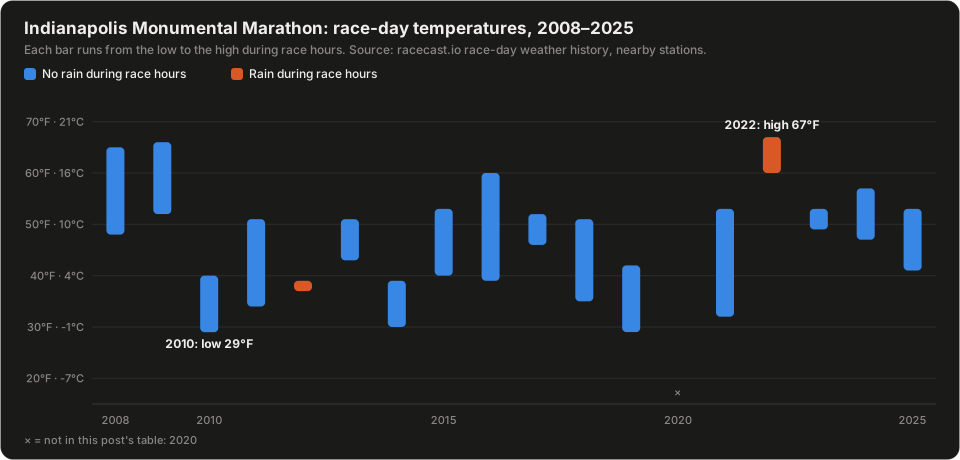
Each bar is one race morning, from the low to the high during race hours. Same data as the table above.
Cold is the usual problem here, not heat. Twelve of 17 years never got above 55°F (13°C) during race hours, and nine had a low at or below 40°F (4°C). Only four years reached 60°F (16°C) or more.
What the Numbers Say About Race Morning
The first thing to notice is how wide the range of starting temperatures is. Lows run from 29°F (-2°C) to 60°F (16°C), a 31°F spread, even though the race date barely moves from year to year. Early November in central Indiana sits between fall and winter, and a single front can change the morning by 20 degrees. The average of 47°F (8°C) describes very few actual race days.
The second is how dry the air usually is. The average dew point is 37°F (3°C), and in cold years it falls into the 20s. That is the opposite of a humid fall marathon. The dew point only stood out in 2022, at 55°F (13°C), and that is the same year the score fell to 5. Our dew point guide explains why a dew point in the 50s costs more than the air temperature alone suggests.
The third is that the course does not add much weather of its own. The organizer describes the route as fast, flat and USATF certified, through downtown Indianapolis and several historic neighborhoods. We do not have a per-year wind history for this race, only the 8 mph (13 km/h) average, so we will not guess at which stretches are exposed. Check the forecast wind direction on race week and plan around it.
The warm years look different from the cold ones. 2008, 2009 and 2022 are the three lowest-scoring editions (8, 8 and 5), and all three had highs of 65°F (18°C) or more. A 2022-style morning is rare here, but it is the one that calls for a different pacing plan.
The Coldest Years: 2010, 2014 and 2019
2010 and 2019 both had a low of 29°F (-2°C). In 2019 the high only reached 42°F (6°C) with a dew point of 19°F (-7°C), the driest air in the record. 2014 was similar, with a range of 30°F to 39°F (-1°C to 4°C), and 2012 stayed between 37°F and 39°F (3°C to 4°C) with light rain. In all of these years the air was cold for the whole run, not just at the start.
The scores for these years are still 9 or 10. Cold, dry and calm is good for running hard. The cost is at the start, where you stand in a corral waiting for your wave, which can be released as late as about 8:25 AM.
The Warmest Year: 2022
2022 is the outlier. The range was 60°F to 67°F (16°C to 19°C), the dew point was 55°F (13°C), and light rain fell during race hours, which is why the RunScore was 5 against a typical 9 or 10. The low was 19°F above the 41°F average low. We do not have a verified record of gusts or problems on the course that day, so we will leave it at the numbers: if you ran Indianapolis in 2022 and remember it as a hard one, the weather data agrees.
The Best Years for Fast Times
2025 started at 41°F (5°C), reached 53°F (12°C), and was partly cloudy with a 41°F (5°C) dew point. It scored a 10. That morning Joseph Whelan ran 2:12:29, the men's course record listed on the official race page. The women's record, 2:31:49 by Lindsey Bradley, came in 2024 at 47°F to 57°F (8°C to 14°C), also partly cloudy. 2025 was also the largest field yet, a record 17,500 participants across all distances, according to the organizer.
How to Prepare for Race Morning
Dress for the corral, not the average. The most common start is in the 30s or 40s °F (0 to 9°C), and you may wait in the start area for up to 25 minutes after the first wave goes. Wear throwaway layers you can drop over the fence at the start. The organizer collects discarded clothing for donation. Our clothing by temperature guide covers what to wear for each range.
Use the indoor warm-up area. The Indiana Convention Center, next to the start, has a warm-up area in Halls A and B on race morning. On a 29°F (-2°C) morning like 2010 or 2019 it makes the wait much easier.
Expect it to warm up as you run. Highs in the record are mostly in the low 50s °F (about 11°C). If you start in a jacket and tights, expect to be comfortable in shorts and a singlet by the second half. Gloves you can tuck away are usually enough.
Drink anyway. Cold air hides thirst. Water is at every aid station and Gatorade at every other one, so take a cup early rather than waiting until you feel dry. See our cold marathon guide for fueling in the cold.
Have a plan B for a 2022-style morning. If the forecast shows 60°F (16°C) or more, or a dew point in the 50s, start a little slower than goal pace and take extra fluids. Use our pace calculator to see what the forecast does to your goal time.
Check the wind on race week. The record only gives an 8 mph (13 km/h) average, so the forecast is the better guide. Our wind guide explains how to adjust for a headwind on a flat course.
This Year
The 2026 race: Saturday, November 7, 8:00 AM start. For the current race-day forecast, weather-adjusted pacing and a gear check, see the race-day forecast and pace calculator on racecast.io.
More Guides
- Indianapolis Monumental Marathon: Race-day forecast, pace calculator and course analysis.
- What to Wear by Temperature: Pick your layers for the start and the finish.
- Running a Cold Marathon: Pacing and fueling when it is below 40°F.
- How Wind Affects Your Marathon: What a headwind costs on a flat course.
- Dew Point and Marathon Performance: Why humidity matters more than the temperature alone.