
Honolulu Marathon Weather History: 25 Years of Race Days
In 25 Honolulu Marathons since 2000, race hours never dropped below 66°F (19°C). The dew point and the warm start decide how hard the day feels.
Most race-weather stories are about a swing from a cold start to a hot finish. Honolulu is the opposite. Across 25 race days in our history, the lowest temperature during the race was 66°F (19°C) and the highest was 81°F (27°C). There has not been a cold Honolulu Marathon morning in that time.
That makes the weather question here a different one. The gun goes off at 5:00 AM under fireworks, in the dark, and the air is already around 70°F (21°C) with a dew point in the mid-60s. The forecast numbers that matter are the dew point and how warm the start is. Here is what the race page's history shows for every Honolulu Marathon run since 2000.
Honolulu Marathon Weather, Year by Year
This is the same history shown on the Honolulu Marathon race page: temperatures are the low and high during race hours, and the dew point is for the same window. Scores are racecast.io's RunScore out of 10, where higher means better running weather. The race runs on the second Sunday of December, so the table covers one weekend a year.
| Year | Conditions | Low / High | Rain | Dew Point | Score |
|---|---|---|---|---|---|
| 2025 | Cloudy, chance of rain | 74°/76°F (23°/24°C) | Light | 72°F (22°C) | 3 |
| 2024 | Partly cloudy | 69°/78°F (21°/26°C) | None | 65°F (18°C) | 4 |
| 2023 | Partly cloudy | 70°/81°F (21°/27°C) | None | 69°F (21°C) | 3 |
| 2022 | Partly cloudy | 75°/78°F (24°/26°C) | None | 64°F (18°C) | 3 |
| 2021 | Partly cloudy, early morning rain | 73°/80°F (23°/27°C) | None | 67°F (19°C) | 3 |
| 2019 | Partly cloudy | 70°/77°F (21°/25°C) | None | 65°F (18°C) | 4 |
| 2018 | Partly cloudy, rain clearing later | 71°/72°F (22°/22°C) | Light | 67°F (19°C) | 4 |
| 2017 | Partly cloudy, late afternoon rain | 71°/76°F (22°/24°C) | None | 64°F (18°C) | 4 |
| 2016 | Partly cloudy | 70°/74°F (21°/23°C) | None | 66°F (19°C) | 4 |
| 2015 | Partly cloudy | 71°/77°F (22°/25°C) | None | 67°F (19°C) | 4 |
| 2014 | Partly cloudy, early morning rain | 70°/72°F (21°/22°C) | Light | 66°F (19°C) | 4 |
| 2013 | Partly cloudy | 70°/78°F (21°/26°C) | None | 65°F (18°C) | 4 |
| 2012 | Partly cloudy | 73°/78°F (23°/26°C) | None | 66°F (19°C) | 3 |
| 2011 | Partly cloudy, rain | 71°/75°F (22°/24°C) | None | 66°F (19°C) | 4 |
| 2010 | Partly cloudy, morning rain | 68°/74°F (20°/23°C) | Light | 66°F (19°C) | 4 |
| 2009 | Partly cloudy | 66°/74°F (19°/23°C) | None | 63°F (17°C) | 5 |
| 2008 | Partly cloudy, chance of rain | 71°/73°F (22°/23°C) | Light | 68°F (20°C) | 4 |
| 2007 | Partly cloudy | 72°/75°F (22°/24°C) | None | 67°F (19°C) | 4 |
| 2006 | Partly cloudy | 70°/75°F (21°/24°C) | None | 60°F (16°C) | 4 |
| 2005 | Partly cloudy | 71°/77°F (22°/25°C) | None | 65°F (18°C) | 4 |
| 2004 | Partly cloudy | 67°/73°F (19°/23°C) | None | 61°F (16°C) | 5 |
| 2003 | Partly cloudy | 74°/78°F (23°/26°C) | None | 63°F (17°C) | 4 |
| 2002 | Partly cloudy | 73°/78°F (23°/26°C) | None | 61°F (16°C) | 4 |
| 2001 | Partly cloudy | 73°/77°F (23°/25°C) | None | 65°F (18°C) | 3 |
| 2000 | Partly cloudy | 68°/76°F (20°/24°C) | None | 65°F (18°C) | 4 |
The table has no 2020 row: the in-person race was canceled that year and run virtually. Conditions describe the whole day, so a row can mention rain that fell outside race hours. The Rain column is race hours only.
Source: racecast.io race-day weather history, 25 race days (2000 to 2025). Race-hours weather from nearby stations, so a spot on the course can differ.
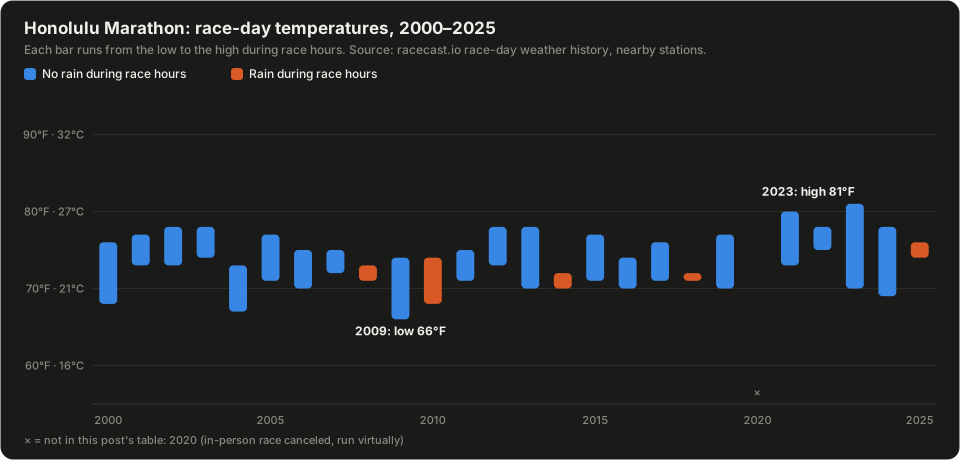
Each bar is one race morning, from the low to the high during race hours. Same data as the table above.
The score never moves much because the temperature barely does. Across 25 race days the race-hours low averaged 71°F (22°C) and the high 76°F (24°C), an average spread of about 5 degrees. The one year that spread more than 10 degrees was 2023, from 70°F (21°C) to 81°F (27°C).
Why the Dew Point Is the Number to Watch
When the low sits around 71°F (22°C) before the sun is even up, there is no cool window to run in. A race that starts in the dark at 5:00 AM does get the coolest part of the day, but in Honolulu that is still a warm one. The temperature range alone shows little difference between a good year and a bad one. The dew point and a warm start together do: the six years that scored a 3 all had a dew point of 64°F (18°C) or more and a low of 70°F (21°C) or warmer.
Dew point is a measure of how much moisture is in the air, and it controls how well sweat evaporates. At 60°F (16°C), the 2006 reading, most runners feel comfortable. At 72°F (22°C), the 2025 reading, sweat sits on the skin and the body cools slowly. Seven of the 25 years had a dew point of 67°F (19°C) or higher, and racecast.io's RunScore was 3 in 2025, 2023 and 2021 among them. Our dew point guide explains how to read it.
The course adds to this. It runs through downtown Honolulu and Waikiki, around Diamond Head, east along Kalanianaole Highway to Hawaii Kai and back to Kapiolani Park. The official site calls it mostly flat except for Diamond Head, with a high point of 124 feet (38 meters) near mile 9. The route follows the coast, so there is no inland cool pocket to look for.
In 20 of 25 years the race-hours low was 70°F (21°C) or warmer, and in 23 of 25 the high stayed at or below 78°F (26°C). The race is consistently warm, not occasionally hot. Plan for warm every year.
The Warmest and Most Humid Years
2023: The Warmest in Our History
The 2023 race hit the highest race-hours temperature in the table, 81°F (27°C), with a low of 70°F (21°C) and a dew point of 69°F (21°C). Partly cloudy skies and a score of 3. The race has no time limit, so runners who finish later spend more of the morning at the warm end of that range.
2025: Warm, Wet and the Stickiest in Our History
The 2025 race (December 14) holds the highest dew point in the history, 72°F (22°C), alongside a race-hours range of 74°F to 76°F (23°C to 24°C). The official recap described a start in light rain and high humidity, with occasional drizzle and deep puddles on parts of the course, though the predicted downpours held off. The men's winner, Tsegay Weldlibanos, ran 2:13:38. The course record is 2:07:59, set by Titus Ekiru in 2019. Our history scored the 2025 morning a 3.
2021 and 2022: Warm Starts
2022 had the warmest low in our history, 75°F (24°C), with a high of 78°F (26°C). 2021 reached 80°F (27°C). A start in the mid-70s fits the pattern here.
The Best Weather Years
2009 and 2004: The Only Scores of 5
The two best years in the history are 2009 (66°F to 74°F, or 19°C to 23°C, dew point 63°F or 17°C) and 2004 (67°F to 73°F, or 19°C to 23°C, dew point 61°F or 16°C). Both had a lower dew point and a cooler high than the typical morning. That is what a good Honolulu day looks like: still warm, but dry enough that sweat works.
2018: The Coolest High, and the Trade Winds
2018 had the coolest race-hours high in the table, 72°F (22°C), with a low of 71°F (22°C). It was also a windy year: race reports at the time said Titus Ekiru came close to the course record despite powerful trade winds. Wind averages about 6 mph (10 km/h) in the race page's history. See our guide on how wind affects marathon pace for what a headwind costs.
How to Prepare for a Warm, Humid 5:00 AM Start
Dress for 70°F (21°C), not for the dark. The pre-dawn start feels like it should need a layer, but the average low during race hours is 71°F (22°C). A singlet and shorts are the right call. If you want something at the start, make it a cheap throwaway, and remember there is no clothing check at the start. Anything left there is donated. Our clothing by temperature guide covers the 70s.
Treat the dew point as your real forecast. If it is 65°F (18°C) or below, expect a normal warm day. If it is 67°F (19°C) or higher, which happened in 7 of 25 years, slow your opening miles and expect to finish slower than your goal on a cooler course. The hot marathon guide walks through the adjustments.
Drink at every aid station. The official site lists 16 aid stations, the first at about 2.5 miles (4 km) and then every 2 to 3 miles (3 to 5 km). In warm, humid air take fluid early rather than waiting until you feel thirsty.
Plan for wet shoes. Rain showed up in 5 of 25 years, always light, but the 2025 race had puddles deep enough to soak a shoe. Anti-chafe balm on the feet is cheap insurance, and socks you are willing to run in wet are a good idea.
Run by effort, and expect the sun to come up on you. The race starts in the dark but most runners finish in daylight, so a visor and sunscreen belong in the plan even for a pre-dawn start.
Walkers and slower runners should plan for more heat, not less. There is no time limit and the finish stays open. The longer you are on the course, the later into the morning you run. Pack for four, five or six hours, not three.
More Honolulu Marathon Guides
- Honolulu Marathon Weather Forecast: See the race-day forecast and pace calculator on racecast.io.
- Running a Hot Marathon: How to adjust pace, fluids and expectations when it is warm.
- Dew Point and Marathon Pace: Why humidity matters more than the temperature.
- What to Wear by Temperature: Kit choices from cold to warm.
- How Wind Affects Marathon Pace: What a headwind costs.