
CIM Weather History: 28 Years of Race-Day Data
CIM averages a 42°F start and has seen rain in 7 of 28 years. See the full race-day weather history for the California International Marathon.
The California International Marathon (CIM) starts at 7:00 AM in early December, at Folsom Dam, and finishes at the State Capitol in Sacramento. Its weather is steady from year to year. Across the 28 years racecast.io has race-day weather for (1997 to 2025), the average start was 42°F (6°C) and the average temperature by a typical finish was 52°F (11°C). Eighteen of those 28 mornings earned a RunScore of 10.
The surprise is in what makes a bad CIM. It is almost never cold. Every one of the seven years with rain during race hours had a low of at least 45°F (7°C), and the worst-scoring morning in our history, 2012, was a warm, wet and windy one. Here is what December on this course looks like, year by year.
The Numbers: 28 Years of CIM Weather
This is the race-day weather history racecast.io shows on the race page: conditions during race hours from nearby stations, newest first. Low and high are the temperatures during race hours. The table has no 2020 row.
| Year | Low / High | Rain | Dew Point | RunScore |
|---|---|---|---|---|
| 2025 | 41 / 45°F (5 / 7°C) | None | 42°F | 10 |
| 2024 | 38 / 57°F (3 / 14°C) | None | 41°F | 10 |
| 2023 | 52 / 63°F (11 / 17°C) | None | 50°F | 8 |
| 2022 | 45 / 56°F (7 / 13°C) | Light | 47°F | 9 |
| 2021 | 43 / 50°F (6 / 10°C) | None | 46°F | 10 |
| 2019 | 53 / 57°F (12 / 14°C) | Light | 53°F | 8 |
| 2018 | 35 / 51°F (2 / 11°C) | None | 39°F | 10 |
| 2017 | 42 / 54°F (6 / 12°C) | None | 39°F | 10 |
| 2016 | 36 / 52°F (2 / 11°C) | None | 40°F | 10 |
| 2015 | 50 / 58°F (10 / 14°C) | Light | 44°F | 10 |
| 2014 | 47 / 56°F (8 / 13°C) | None | 49°F | 9 |
| 2013 | 26 / 37°F (-3 / 3°C) | None | 24°F | 10 |
| 2012 | 55 / 58°F (13 / 14°C) | Moderate | 54°F | 6 |
| 2011 | 33 / 50°F (1 / 10°C) | None | 26°F | 10 |
| 2010 | 49 / 55°F (9 / 13°C) | Light | 49°F | 9 |
| 2009 | 31 / 44°F (-1 / 7°C) | None | 26°F | 9 |
| 2008 | 40 / 43°F (4 / 6°C) | None | 40°F | 10 |
| 2007 | 43 / 54°F (6 / 12°C) | None | 28°F | 10 |
| 2006 | 31 / 54°F (-1 / 12°C) | None | 34°F | 10 |
| 2005 | 33 / 47°F (1 / 8°C) | None | 30°F | 10 |
| 2004 | 34 / 48°F (1 / 9°C) | None | 33°F | 10 |
| 2003 | 52 / 58°F (11 / 14°C) | None | 49°F | 8 |
| 2002 | 41 / 53°F (5 / 12°C) | None | 39°F | 10 |
| 2001 | 48 / 53°F (9 / 12°C) | Moderate | 47°F | 7 |
| 2000 | 43 / 44°F (6 / 7°C) | None | 41°F | 10 |
| 1999 | 37 / 52°F (3 / 11°C) | None | 39°F | 10 |
| 1998 | 35 / 42°F (2 / 6°C) | None | 36°F | 10 |
| 1997 | 52 / 53°F (11 / 12°C) | Light | 52°F | 8 |
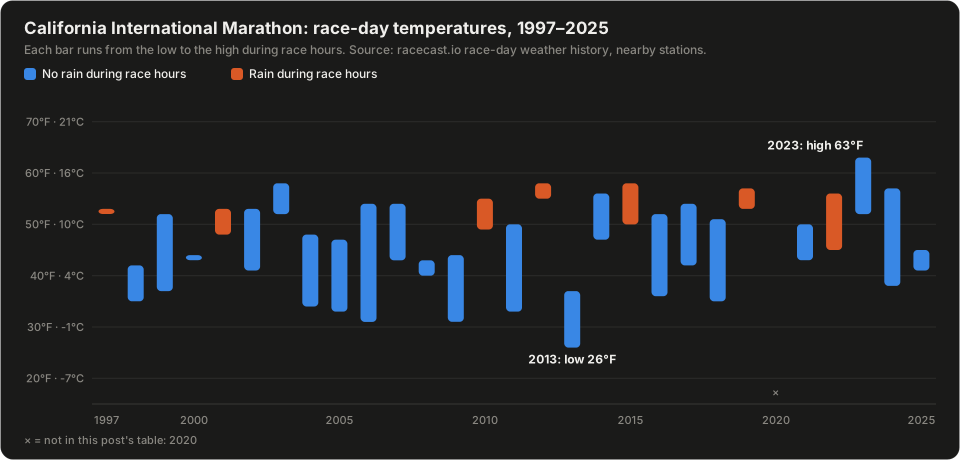
Each bar is one race morning, from the low to the high during race hours. Same data as the table above.
Rain and cold have never shown up together during race hours at CIM in our history. The seven wet years all had race-hour lows of 45°F (7°C) or higher, and the eight years with a low of 35°F (2°C) or colder were all dry.
Why December in Sacramento Looks Like This
CIM runs in early December, in the Sacramento Valley's wet season. Most mornings are the kind of cold, dry and still we see in the table: the average dew point is 41°F (5°C) and the average wind is 6 mph (10 km/h). The five coldest starts in our history, 2013, 2009, 2006, 2011 and 2005, all had no rain during race hours. The wet years sit at the mild end of the table, which fits a rainy day coming with cloud cover instead of a cold clear sky, though our data cannot tell us the cause.
The course is a net downhill point-to-point. It has about 553 ft (169 m) of climbing and 893 ft (272 m) of descent, a net drop of about 340 ft (104 m), and it is faster than 93% of the marathon courses racecast.io has mapped. The steepest mile averages a 0.8% grade. With little terrain to deal with, the weather is the main variable, and the start time matters: a 7:00 AM gun at Folsom Dam means most runners start near the day's low and finish after it has climbed a few degrees.
The Worst Weather Years
2012: Wind and Rain on the Way In
CIM on December 2, 2012 is the lowest-scoring morning in our history, a 6 with moderate rain, a 55°F (13°C) low and a 58°F (14°C) high. The official recap from the Sacramento Running Association describes rain and wind at the start, with conditions improving along the way from Folsom to the Capitol. Winner Daniel Tapia ran 2:16:29 and called it windy and rainy. The field was also unusual: Hurricane Sandy had canceled the New York City Marathon a few weeks earlier, and some runners, women's winner Alisha Williams among them, ended up in Sacramento instead. Of the 6,474 marathoners who started, 6,185 finished.
2001 and 2019: Wet, Warmer Mornings
2001 recorded moderate rain with a 48°F (9°C) low and a 53°F (12°C) high, scoring a 7. In 2019 the low was 53°F (12°C) and rain came early in the morning, scoring an 8. Both years were wet but not cold.
2023: The Warmest in Our History
The warmest CIM in our history reached 63°F (17°C), with a low of 52°F (11°C) and a 50°F (10°C) dew point. It was dry, and the warmth and a 50°F (10°C) dew point pulled its score down to an 8.
2013: The Coldest Start
The coldest start in our history was December 8, 2013, at 26°F (-3°C), with a high of only 37°F (3°C) and a dew point of 24°F (-4°C). It was clear and dry, and it is the coldest start on file.
The Best Weather Years
Perfect CIM mornings are common. 2024 (38 to 57°F, or 3 to 14°C), 2018 (35 to 51°F, or 2 to 11°C), 2017 (42 to 54°F, or 6 to 12°C) and 2016 (36 to 52°F, or 2 to 11°C) all scored 10, with clear or partly cloudy skies, no rain and dew points near 40°F (4°C). 2021 (43 to 50°F, or 6 to 10°C) and 2025 (41 to 45°F, or 5 to 7°C) were cooler and flatter still, with the 2025 range only 4 degrees wide.
The common pattern is a start in the upper 30s to low 40s that warms into the low to mid 50s. That is the temperature range most marathoners run best in.
Only 5 of the 28 years (2013, 2011, 2009, 2007 and 2005) had a dew point of 30°F (-1°C) or lower. In the other 23 years the dew point was in the 30s or higher, and in the wettest years it reached the 50s.
How to Prepare for CIM Weather
Dress for the start, not the finish. The average start is 42°F (6°C) and plenty of years open in the 30s. You will stand in the Folsom Dam corrals before the 7:00 AM start in that air. Wear throwaway layers you can drop at the line. Our race-day clothing by temperature guide covers what to wear at each range.
Plan for gloves and sleeves. A start between 35 and 45°F (2 to 7°C) with a high in the 50s is the typical day. Gloves you can tuck away and arm sleeves give you the most options as the morning warms. If the start is in the 30s, read running a cold marathon.
Keep a rain layer in the bag. One year in four has rain in race hours, and those mornings are mild, so a thin rain jacket or poncho at the start is the right amount. Wet and 50°F (10°C) is easy to manage if you plan for it.
Do not skip fluids in cold weather. With an average dew point of 41°F (5°C) the air is dry, and cold runners drink less than they need. Take the planned fluids at the aid stations anyway.
Treat wind as the wildcard. The average is 6 mph (10 km/h), but the record range is 1 mph in 2008 to 16 mph in 1997. On a day with a stiff wind, tuck into a pack and run by effort. Our guide on how wind affects the marathon explains the cost.
Do not count on the downhill alone for a PR. The net drop of about 340 ft (104 m) helps, but a wet and windy day like 2012 can cancel it. Check the forecast in the final days before the race and adjust pace for the real conditions, not the course profile.
More CIM Weather Resources
- California International Marathon forecast: See the race-day forecast and pace calculator on racecast.io.
- What to Wear by Temperature: A range-by-range clothing guide for race morning.
- Running a Cold Marathon: How to handle the starts in the 30s.
- How Wind Affects the Marathon: What a headwind actually costs.