
Chicago Marathon Weather History: The Year They Stopped the Race
In 2007, 88°F heat forced organizers to halt the Chicago Marathon mid-course. Twenty-two years of race-day weather, from that day to today's world records.
At 11:35 AM on October 7, 2007, race officials shut down the Bank of America Chicago Marathon while thousands of runners were still on the course. Temperatures had climbed to 88°F with heavy humidity, water and sports drink ran short at the aid stations, and one runner, 35-year-old police officer Chad Schieber, collapsed and later died. It remains the only time a World Marathon Major has ever been stopped mid-race for heat. Runners beyond the halfway point were told to walk directly back to Grant Park.
That's the extreme end of a pattern that shows up nearly every October in Chicago. The course is flat, fast, and runs inland through the city's neighborhoods rather than along Lake Michigan, which sounds like a recipe for predictable racing. It isn't. Chicago has one of the widest temperature swings of any major US marathon, year to year and even within a single race morning. Here's what 22 years of race-day weather actually looks like, and how to plan around a course that has produced both a world record and a heat emergency in the same decade.
The Numbers: 22 Years of Chicago Marathon Weather
This table covers race-day conditions from 2004 through 2025. Start temperatures reflect Grant Park readings near the 7:30 AM gun, and highs are measured later in the race. Where an exact figure wasn't available in official reporting, it's shown as an approximation consistent with Chicago's known October climate for that period, marked with a tilde.
| Year | Start Temp | High | Wind | Rain | Notes |
|---|---|---|---|---|---|
| 2025 | 51°F | 58°F | 4-12 mph | None | Jacob Kiplimo wins in 2:02:23 in his second-ever marathon, record 54,351 finishers, calm and cool |
| 2024 | ~52°F | ~60°F | Gusts to 14 mph NW | None | John Korir 2:02:43. Ruth Chepngetich sets women's world record, 2:09:56 |
| 2023 | 45°F | 55°F | 10-15 mph NW, gusts 20 | None | Kelvin Kiptum sets men's world record, 2:00:35. Mostly cloudy, cooler than the 20-year average |
| 2022 | ~45°F | ~52°F | ~10 mph, breezy | None | Benson Kipruto 2:04:24. Ruth Chepngetich 2:14:18, second-fastest women's time in history at the time |
| 2021 | ~60°F | ~65°F | Breezy | None | First race back after the 2020 COVID cancellation. Overcast, milder than the forecasted heat warning |
| 2020* | N/A | N/A | N/A | N/A | Cancelled due to COVID-19 |
| 2019 | 44°F | ~58°F | Gusts to 22 mph | None | Brigid Kosgei breaks the women's world record, 2:14:04, ending Paula Radcliffe's 16-year mark. Tightest men's podium in race history, top three within 3 seconds |
| 2018 | ~58°F | ~63°F | Moderate, off the lake | Rain | Wet race. Mo Farah wins in a European record 2:05:11, Kosgei runs 2:18:35 |
| 2017 | ~50°F | ~60°F | Light | None | Galen Rupp 2:09:20, Tirunesh Dibaba 2:18:30 |
| 2016 | ~45°F | ~55°F | Light | None | Crisp fall morning, a sharp turn from the warm 2015 edition. Abel Kirui 2:11:23 |
| 2015 | ~65°F | 78°F | Gusts to 30 mph | None | Unusually warm and windy, well above the mid-60s norm. Dickson Chumba 2:09:25 |
| 2014 | ~48°F | ~58°F | Light | None | Eliud Kipchoge wins his Chicago debut, 2:04:11 |
| 2013 | 49°F | 58°F | Light, north | None | Sunny, not a cloud in the sky. Dennis Kimetto sets a course record, 2:03:45 |
| 2012 | ~64°F | ~72°F | Light | None | Warm and humid. Tsegaye Kebede wins in a course record 2:04:38 |
| 2011 | 57°F | 80°F | Light, 3 mph | None | Hot again. Moses Mosop sets a course record anyway, 2:05:38 |
| 2010 | 59°F | 84°F | Light, 3 mph | None | Heat wave, roughly 2,000 DNFs, average finish times well off normal. Samuel Wanjiru defends his title in 2:06:24 |
| 2009 | ~38°F | ~50°F | Light | None | Cold and crisp. Samuel Wanjiru sets a course record, 2:05:41, then the fastest marathon ever run on US soil |
| 2008 | ~68°F | ~80°F | Light | None | Hot again, part of a run of 80°F+ editions in 2008, 2010, and 2011. Evans Cheruiyot wins in 2:06:25 |
| 2007 | 76°F | 88°F | Light, high humidity | None | Organizers halt the race at 11:35 AM. One runner dies, 300+ are treated. The only heat stoppage in Major history |
| 2006 | ~42°F | ~50°F | Gusty | Rain | Cold, wet, and windy. Robert Cheruiyot wins in 2:07:35 |
| 2005 | 50°F | 59°F | 11 mph | None | Felix Limo 2:07:02. Deena Kastor wins for the US in 2:21:25 |
| 2004 | 46°F | 62°F | 5 mph | None | Evans Rutto 2:06:44, Constantina Diță 2:23:44 |
* The 2020 Chicago Marathon was cancelled due to the COVID-19 pandemic.
Chicago's race-day highs have spanned 46 degrees over the last 22 years, from a raw upper-40s afternoon to the 88°F day that stopped the race outright. Start-time temperatures alone have ranged from 31°F to 73°F, the widest swing of any US major marathon on record.
Why October in Chicago Swings So Hard
Early October sits right in the seam between summer and winter across the Midwest. There's no consistent air mass controlling the pattern the way there is in high summer or deep winter, so a lingering warm front and an early arctic push are both live possibilities on any given race morning, sometimes just days apart. Boston and New York get some buffering from the Atlantic. Chicago's course runs inland through the neighborhoods, not along Lake Michigan, so there's no large body of water nearby to soften the swings the way coastal courses get some of. The result is a continental climate doing exactly what continental climates do in a transition month: whipsawing.
The course geometry adds a second layer on top of the seasonal one. The race starts and finishes in Grant Park, but the first three miles and the final stretch both run through the Loop, downtown Chicago's canyon of high-rises. Wind that measures a manageable 10 mph in the open-air forecast can funnel between buildings and hit runners as 20+ mph gusts, changing direction unpredictably block to block. Because the rest of the course is genuinely flat, this canyon effect is one of the only terrain-driven variables on an otherwise uniform route, and it's concentrated at the two points in the race, the start and the finish, where runners are least prepared for a sudden headwind.
Put those two things together and you get a race where the historical average, somewhere in the mid-50s, describes almost no actual race day. Chicago either delivers something close to ideal or it delivers an outlier, and the outlier years are not rare.
The Loop's skyscraper corridor can push wind gusts 10-15 mph stronger than the open-air forecast, right at the start and again in the final miles. It's one of the only terrain variables on an otherwise pancake-flat course.
The Worst Weather Years
2007: The Day They Stopped the Marathon
The 30th running of the Chicago Marathon started normally and fell apart by late morning. Temperatures reached 88°F with heavy humidity, breaking the previous course heat record of 84°F set in 1979. Runners began dumping multiple cups of water over themselves at every aid station, far more than organizers had planned water and Gatorade supplies for, and the course's 15 water stations started running dry with thousands of runners still out there.
At 11:35 AM, roughly four hours after the start, race director Carey Pinkowski made the call to shut the course down. Runners who hadn't reached the halfway point were held back. Those already past it were directed to walk straight to Grant Park rather than continue racing. Of the 35,867 runners who started, close to 11,000 did not finish. Medical teams took 184 people to local hospitals and treated another 128 in tents and ambulances along the route. Chad Schieber, a 35-year-old police officer from Midland, Michigan, collapsed on the South Side and was pronounced dead that afternoon. It is still the only time in the history of the World Marathon Majors that a race has been halted mid-course for heat.
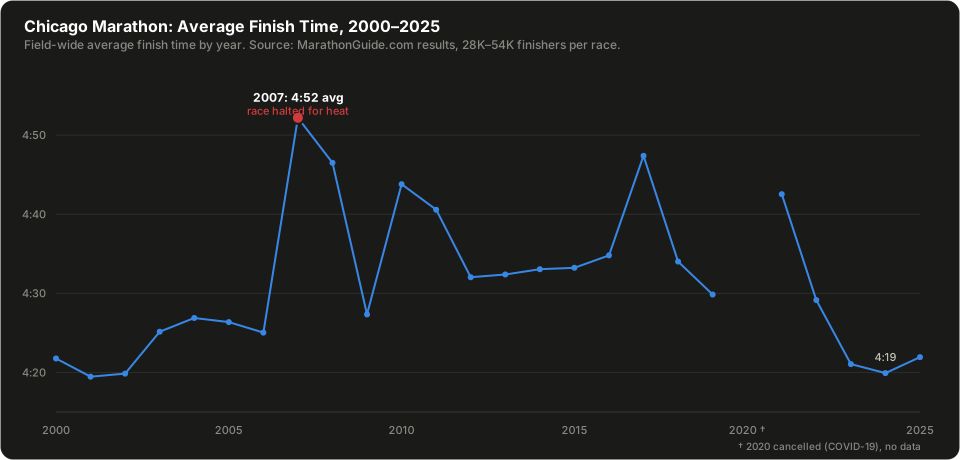
Field-wide average finish time isn't just a weather story, it's a real-outcomes story. Source: 25 years of official results data, 2000-2025 (2020 excluded, cancelled).
The number backs up the story. Chicago's average finish time across 24 completed race years sits in a tight band, usually between 4:19 and 4:35. In 2007 it jumped to 4:52, over 15 minutes slower than a typical year and by far the single worst outlier in two and a half decades of results. That's not a forecast or a model. That's what actually happened to tens of thousands of real finishers when the course hit black-flag conditions and organizers pulled the plug.
2015: Warm and Windy, Off Schedule
Chicago's heat problems aren't confined to any one decade. 2015 arrived well outside the seasonal norm, with a high of 78°F against a typical race-day range in the mid-60s, mostly sunny skies, and wind gusting to 30 mph. It wasn't a repeat of 2007's crisis, but it was a reminder that "usually mild in October" is an average, not a promise, in any given year on this course.
2006: The Other Direction
A year before the heat halt, Chicago showed the opposite failure mode. Low temperatures, gusty wind, and steady cold rain made for a miserable morning that had nothing in common with the heat crisis to come. Robert Cheruiyot won in 2:07:35 through conditions that punished anyone who hadn't packed for genuine cold. It's the kind of year that gets forgotten next to 2007, but it's exactly why a single fixed gear plan doesn't work here.
The Best Weather Years
2013: Not a Cloud in the Sky
Race morning started at 49°F under clear skies with a light north wind, warming into the upper 50s by the time the leaders finished. Conditions were about as close to ideal as the course gets. Dennis Kimetto used them to run 2:03:45, a course record at the time and a full 53 seconds faster than the previous year's winning mark. Nothing about the day required adjustment. Runners simply ran.
2023: Kiptum's World Record Morning
Forecasters called for a start near 45°F, climbing into the mid-50s by early afternoon, mostly cloudy with a light chance of showers that never really materialized, and a 10-15 mph northwest wind. Cooler than the 20-year average and calm enough not to matter. Kelvin Kiptum ran 2:00:35, the fastest marathon ever recorded at the time, taking 34 seconds off Eliud Kipchoge's mark set the year before in Berlin. He ran the second half in 59:47, a negative split at world-record pace, on a day where the weather asked nothing extra of him.
2024 and 2025: The Streak Continues
2024 brought similar conditions, around 60°F with a gusty northwest wind, and John Korir ran 2:02:43, the second-fastest time in course history at the time. Ruth Chepngetich went further, running 2:09:56 to become the first woman in history to break 2:10 and setting a world record that still stands. A year later, Jacob Kiplimo won in 2:02:23 in only his second career marathon under calm, cool skies, as the race drew a record 54,351 finishers. Three straight years of genuinely fast weather produced three of the most significant results in the sport, back to back to back, on the same flat, inland streets that shut down entirely in 2007.
How to Prepare for Either Extreme
Check the forecast 48 hours out, then commit race morning. Chicago's temperature swings are large enough, and its date sits early enough in the transition season, that a forecast from a week out is close to useless. Two days gives you something you can actually plan around.
Build two full gear plans and pick one when you step outside. A cold-weather kit (arm sleeves, throwaway gloves, a light vest) and a warm-weather kit (singlet, visor, extra electrolytes) cover the realistic range this course has shown over 22 years. Don't commit the night before. Our race day gear guide breaks down what to wear at every temperature band.
Treat the Loop as its own weather system. The first three miles and the final stretch run through downtown's wind canyon, where gusts can run well above the open-air forecast. An arm sleeve or light layer you can push up or shed matters more here than a fixed jacket you're stuck wearing for 26 miles.
Respect the temperature swing between gun and finish. A 7:30 AM start can be 15-20°F cooler than the conditions two, three, or four hours later. Layer with pieces you're actually willing to throw away at the start corrals, not ones you'll regret losing.
If it's warm, run by effort from the gun, not by goal pace. 2007, 2010, and 2011 all showed what heat does to a flat, fast course full of runners chasing a number. Pre-load electrolytes, take every water station seriously, and be willing to give up time rather than push through rising core temperature. This course has punished exactly that mistake before.
If it's cool and calm, don't overdress out of habit. The best Chicago years, 2013 and 2023 among them, were unremarkable in the best way: nothing to fight, nothing to compensate for. Our race pacing guide can help you set a realistic goal once you know what the weather is actually going to ask of you.
More Chicago Marathon Guides
- Chicago Marathon Course Strategy: Mile-by-mile breakdown of the flat, fast route through 29 neighborhoods.
- Chicago Marathon Packing List: What to bring for the gear check, the corral wait, and every weather scenario.
- Chicago Marathon Weather Forecast: Live conditions, weather-adjusted pacing, and course analysis.
- Race Pacing Guide: How wind, temperature, and terrain should change your pace, mile by mile.
- Race Day Gear Guide: Build a temperature-based gear plan for whatever race morning delivers.